
Better Outcomes by Better Outcomz · Customer Service
Understand whether the customer was actually helped.
A service interaction can score well on tone, process and compliance while the customer's problem remains unresolved. Repeat contact, stalled hand-offs and avoidable effort are invisible when each conversation is reviewed in isolation.
What Better Outcomes does here
Understand whether the customer was actually helped.
Traditional QA can tell you whether an adviser followed a process. Better Outcomes goes further by helping organisations understand whether the interaction moved the customer towards the right resolution.
Analyse repeat contact, unresolved issues, poor hand-offs, customer effort and the behaviours associated with stronger service outcomes.
- 01
Resolution as the outcome
Assess whether the interaction moved the customer towards the right resolution, not just whether the adviser followed the process.
- 02
Repeat-contact and journey view
Earlier contacts, CRM events and follow-ups are assembled alongside the interaction so the reviewer can see why the customer came back.
- 03
Cross-channel consistency
Voice, chat, email and digital interactions are evaluated against the same criteria, making differences between teams and channels visible.
- 04
Coaching from confirmed findings
Effective and ineffective behaviours are identified with the evidence attached, so coaching is targeted and specific.
Walkthrough
One customer service journey, step by step.
A utilities contact centre wants to understand why customers who called about a billing change are calling back within a fortnight. Details are illustrative; the screens are real.
Step 1 of 4
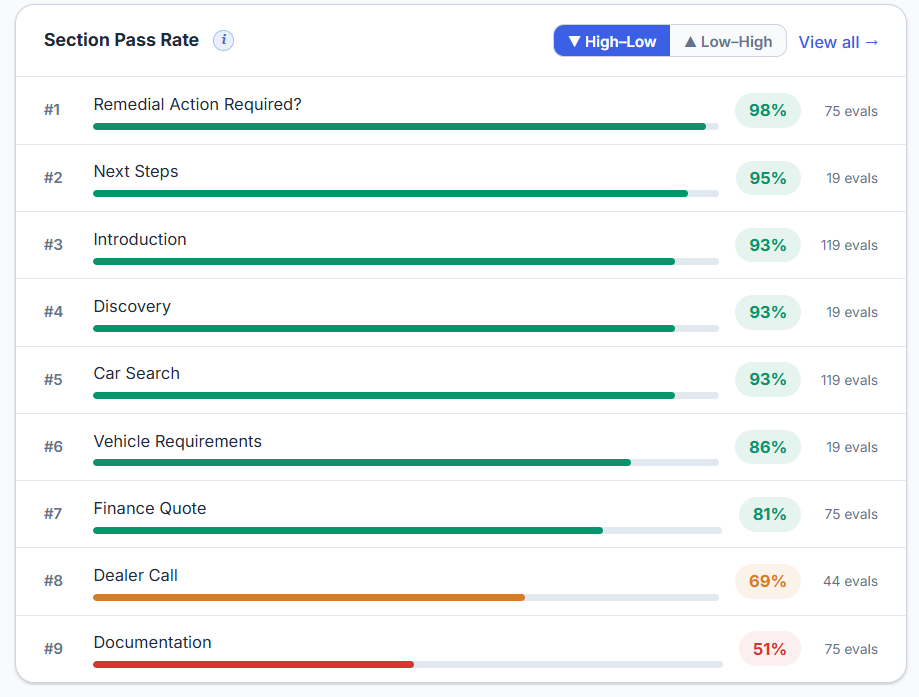
Every billing conversation is assessed on whether the customer was helped
The outcome is defined as the customer's billing question resolved with no need for a further contact. Better Outcomes evaluates every connected voice and chat interaction against that outcome and shows where in the journey resolution is falling short.
- Resolution assessed, not just process adherence
- Weakest journey stages visible across every interaction
Step 2 of 4
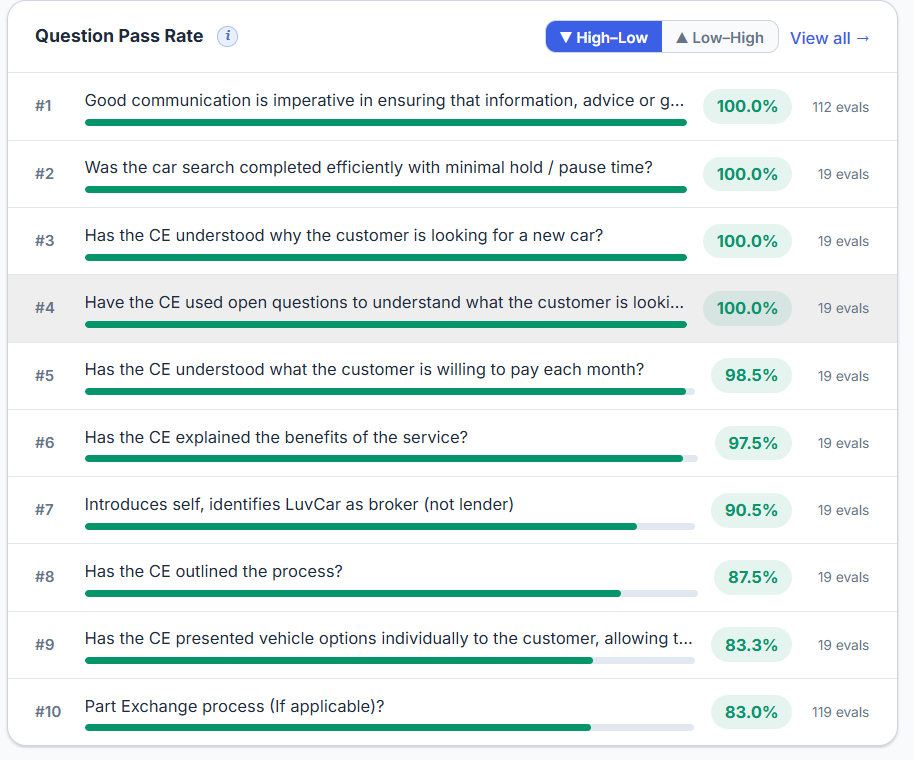
The behaviours linked to repeat contact become visible
Question-level pass rates show that interactions followed by a repeat contact far more often lacked a clear confirmation of what would change on the next bill and when. The gap is a behaviour, not an individual.
- Behaviours ranked across the population
- Effective adviser behaviours identified alongside the gaps
Step 3 of 4
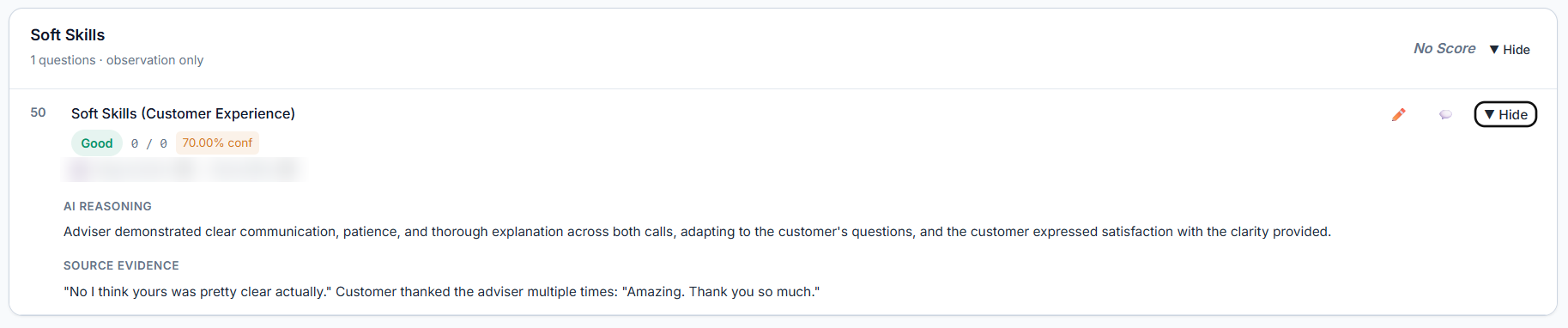
The evidence behind each finding is one click away
A team lead opens a flagged call and sees the AI reasoning next to the moment the explanation was skipped, then checks the repeat contact that followed. The coaching conversation starts from what happened to the customer.
- Reasoning beside verbatim evidence
- Repeat contact linked to the original interaction
Step 4 of 4
Coaching, a script change and a falling repeat-contact rate
Confirming the next-bill change becomes a coaching focus and a small script addition. The KPI view tracks the pass rate for that behaviour and the repeat-contact outcome over the following weeks, so the team can see whether the change is working.
- Improvement tracked at population level
- Consistency compared across teams and channels



In practice
What this looks like on a real journey.
- Example 01
First-contact resolution is falling
Better Outcomes shows the journey stages and behaviours most often associated with a second contact, rather than relying on a post-call survey.
- Example 02
A hand-off keeps failing
Journey evidence shows the commitment made on the call and whether the receiving team acted on it - highlighting the process gap, not the adviser.
- Example 03
Consistency across channels
The same outcome criteria applied to chat and voice reveal where a channel, not an individual, is producing weaker outcomes.
Illustrative scenarios · Findings are surfaced for human review, not decided automatically
The question this answers
“Did the customer get the help they needed?”
What your team gains
- Identify drivers of first-contact resolution
- Understand why customers contact the organisation again
- Detect avoidable friction in customer journeys
- Highlight effective adviser behaviours
- Identify targeted coaching opportunities
- Improve consistency across teams and channels


Real Better Outcomes product screens · Shown with test data
AI assurance and explainability
AI you can evidence, not just trust.
The AI does not simply generate a score. It produces an assessment that a reviewer can check against the evidence used to reach it - and change if the evidence does not support it.
Your data
Customer data is not used to train public or general-purpose AI models. Products are hosted on UK infrastructure with access segregated by organisation, team and user.
Security and governance/ 01
Configurable outcome frameworks
Your outcome definitions, scorecards and rules - applied consistently across every connected interaction.
/ 02
Evidence behind every assessment
Each finding links to the interaction, CRM record and journey events it was drawn from.
/ 03
Explainable reasoning
The criteria applied and the reasoning followed are shown beside the evidence, not hidden in a score.
/ 04
Human-in-the-loop review
Reviewers confirm, reject, escalate or override - with authority to change the outcome and a recorded rationale.
/ 05
Confidence thresholds
Where applicable, low-confidence findings route to human review before any action is taken.
/ 06
Audit history
Findings, decisions, overrides and model versions are written to an append-only audit history.
/ 07
Configurable escalation
Route confirmed findings to remediation, coaching or compliance queues according to your governance model.
/ 08
Role-based access
Named permissions by organisation, team and role, with MFA and lifecycle management.
/ 09
Reporting and governance
Trend, calibration and override reporting for quality, operations, risk and Board oversight.
/ 10
Data controls
UK product hosting, tenant segregation and defined data scope agreed per deployment.
Frequently asked
Questions buyers ask us first.
- How is this different from our existing contact centre QA tool?
- Most QA tools score the conversation. Better Outcomes assesses whether the customer's issue was actually resolved by placing the interaction alongside earlier contacts, CRM events and follow-ups. It answers whether the customer was helped, not only whether the process was followed.
- Does it work across chat, email and voice?
- Yes. Voice, chat, email and digital interactions you connect are evaluated against the same outcome criteria, so differences between channels and teams are visible on a like-for-like basis.
- Can we identify why customers contact us again?
- Better Outcomes links repeat contacts to the interaction and journey events that preceded them and surfaces the recurring stages and behaviours most often associated with a second contact. Findings are reviewed by your people before action is taken.
Insights for Customer Service teams
Thinking worth taking back to your team.
- Quality & Compliance6 min readStop scoring calls. Start scoring outcomes.Christian Henson explains how Better Outcomes helps organisations move beyond sampled calls to assess customer outcomes across the whole journey.Read the essay
- Customer Outcomes9 min readVulnerability is not a flagChristian Henson argues that firms should treat vulnerability as changing customer context, using data and AI to prompt human attention without turning support into automated profiling.Read the essay
Working session
See Better Outcomes on your customer journey.
Bring one representative customer journey and we'll show how Better Outcomes could assess it across interactions, CRM evidence and customer outcomes. No customer data is required for the first session.