
Better Outcomes by Better Outcomz · QA & Coaching
Move from sampled QA to evidence-led performance improvement.
QA teams listen to a handful of calls per adviser per month, calibrate slowly and spend much of their time finding something worth reviewing. Coaching arrives weeks after the behaviour it addresses, and nobody can say whether it changed the outcome.
What Better Outcomes does here
Move from sampled QA to evidence-led performance improvement.
Better Outcomes enables QA and coaching teams to analyse far more interactions while focusing human expertise where it adds the greatest value.
Instead of spending time searching for calls to review, teams can focus on the behaviours, interactions and outcomes that warrant attention.
- 01
Population-scale evaluation
Every connected interaction is assessed against your scorecard and outcome criteria, so reviewers start from findings rather than a random sample.
- 02
Reviewer focus
Confidence levels and exceptions route the interactions that warrant human attention to reviewers, with the evidence attached.
- 03
Coaching priorities
Question- and section-level pass rates identify the behaviours to coach for each individual, team and journey stage.
- 04
Improvement tracking
Trends over time show whether coaching and process changes are influencing the outcomes customers receive, with AI evaluation accuracy tracked alongside.
Walkthrough
One qa & coaching journey, step by step.
A QA team of four reviews two calls per adviser per month across 120 advisers and wants to spend that time where it matters. Details are illustrative; the screens are real.
Step 1 of 4
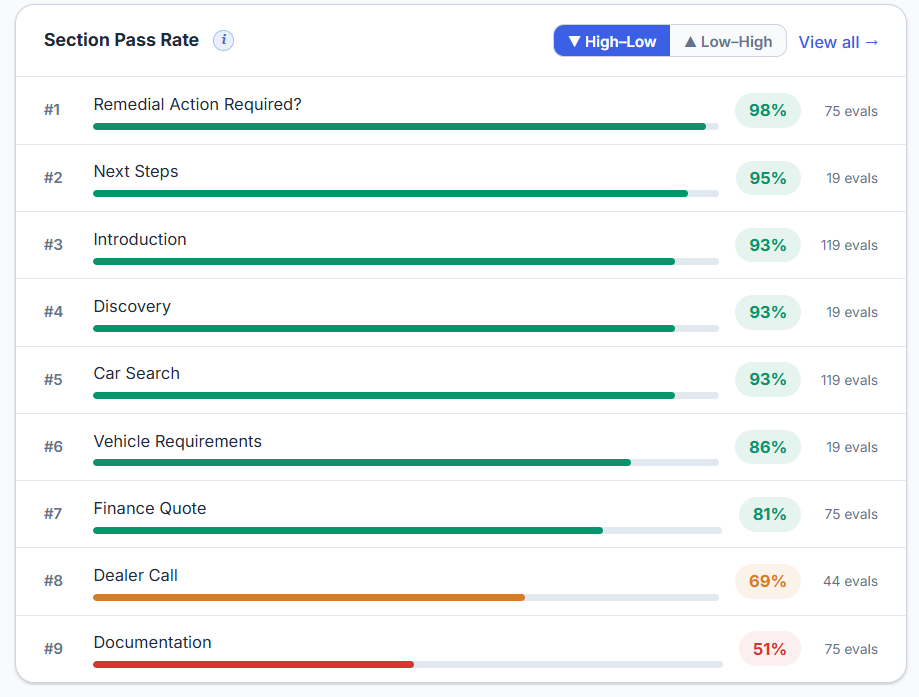
Every connected interaction is evaluated against the scorecard
The team's existing scorecard and outcome criteria are configured in Better Outcomes. Instead of a sample, every call, chat and email is assessed and the weakest sections across the operation are visible immediately.
- Existing scorecard applied at population scale
- Section pass rates replace the search for calls to review
Step 2 of 4
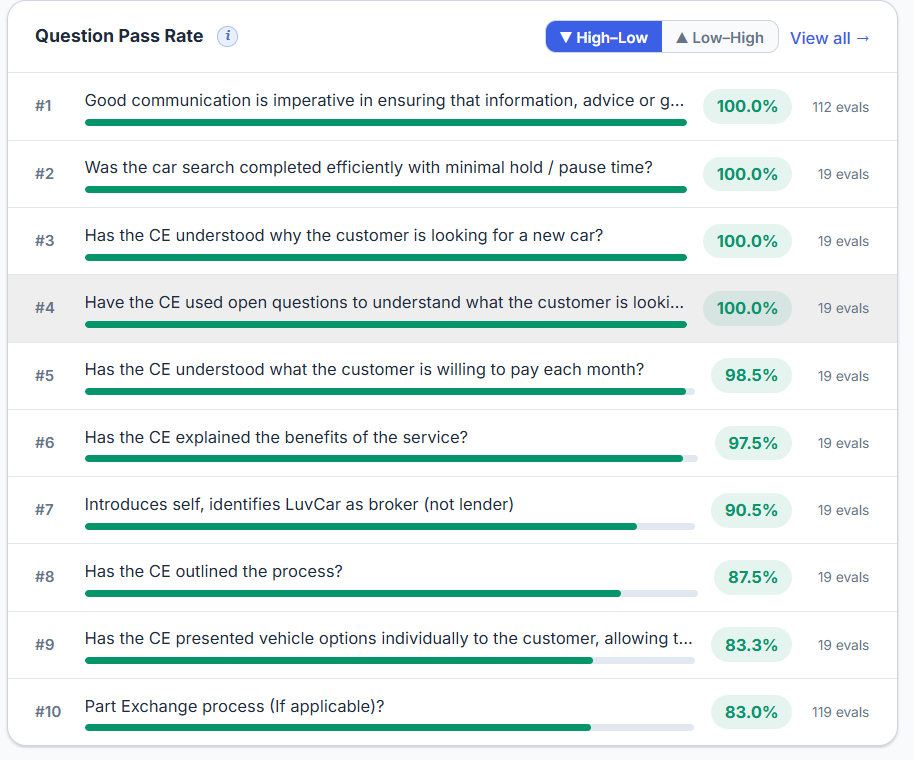
Coaching priorities emerge from question-level pass rates
Question-level results show two behaviours account for most of the weak outcomes on one team. Those become the coaching focus; the reviewers no longer need to find examples by listening at random.
- Behaviours ranked by how often they are missed
- Individuals, teams and journeys compared on the same criteria
Step 3 of 4
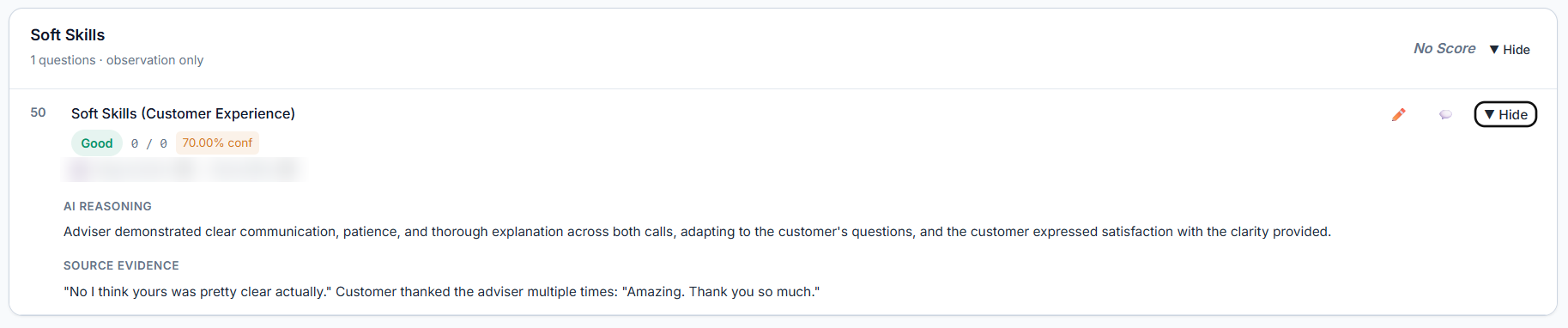
Reviewers judge the evidence rather than hunt for it
Findings below a confidence threshold, and any the AI marks as uncertain, are routed to a reviewer with the reasoning and verbatim evidence attached. The reviewer confirms, rejects or investigates, and each decision calibrates the system.
- Human expertise focused on exceptions and calibration
- Every reviewer decision recorded against the finding
Step 4 of 4
The team can see whether coaching changed the outcome
The KPI view tracks the coached behaviours and AI evaluation accuracy over the following weeks, so the QA lead can show leadership what improvement activity actually did.
- Improvement tracked at population level
- AI evaluation accuracy reported alongside



In practice
What this looks like on a real journey.
- Example 01
A team lead has an hour for coaching
Better Outcomes shows the two behaviours most associated with weaker outcomes on their team and the interactions that evidence them.
- Example 02
Calibration drifts between reviewers
Reviewer decisions and overrides are recorded against the AI finding, making calibration visible and discussable.
- Example 03
Did the coaching work?
Pass rates for the coached behaviour are tracked before and after, at the population level rather than the next sampled call.
Illustrative scenarios · Findings are surfaced for human review, not decided automatically
The question this answers
“Where should human reviewers focus?”
What your team gains
- Reduce dependence on small QA samples
- Analyse performance consistently across larger populations
- Identify coaching priorities
- Compare individuals, teams and customer journeys
- Review the evidence behind each assessment
- Track whether improvement activity is influencing outcomes


Real Better Outcomes product screens · Shown with test data
AI assurance and explainability
AI you can evidence, not just trust.
The AI does not simply generate a score. It produces an assessment that a reviewer can check against the evidence used to reach it - and change if the evidence does not support it.
Your data
Customer data is not used to train public or general-purpose AI models. Products are hosted on UK infrastructure with access segregated by organisation, team and user.
Security and governance/ 01
Configurable outcome frameworks
Your outcome definitions, scorecards and rules - applied consistently across every connected interaction.
/ 02
Evidence behind every assessment
Each finding links to the interaction, CRM record and journey events it was drawn from.
/ 03
Explainable reasoning
The criteria applied and the reasoning followed are shown beside the evidence, not hidden in a score.
/ 04
Human-in-the-loop review
Reviewers confirm, reject, escalate or override - with authority to change the outcome and a recorded rationale.
/ 05
Confidence thresholds
Where applicable, low-confidence findings route to human review before any action is taken.
/ 06
Audit history
Findings, decisions, overrides and model versions are written to an append-only audit history.
/ 07
Configurable escalation
Route confirmed findings to remediation, coaching or compliance queues according to your governance model.
/ 08
Role-based access
Named permissions by organisation, team and role, with MFA and lifecycle management.
/ 09
Reporting and governance
Trend, calibration and override reporting for quality, operations, risk and Board oversight.
/ 10
Data controls
UK product hosting, tenant segregation and defined data scope agreed per deployment.
Frequently asked
Questions buyers ask us first.
- Does this remove the need for human QA reviewers?
- No. Better Outcomes evaluates every connected interaction and routes the ones that warrant attention to reviewers with the evidence attached. Human reviewers confirm, reject or investigate findings and their decisions calibrate the system. Their time shifts from searching to judging.
- How accurate is the AI evaluation?
- AI evaluation accuracy is tracked continuously against reviewer decisions and reported in the platform. In live deployment it has run at 99.3 per cent. Every finding still carries its reasoning, evidence and confidence so reviewers can check it.
- Can we use our existing scorecards?
- Yes. Your scorecards and outcome criteria are configured directly in Better Outcomes, so question- and section-level pass rates map to the framework your teams already recognise.
Insights for QA & Coaching teams
Thinking worth taking back to your team.
- Quality & Compliance6 min readStop scoring calls. Start scoring outcomes.Christian Henson explains how Better Outcomes helps organisations move beyond sampled calls to assess customer outcomes across the whole journey.Read the essay
- AI Governance9 min readAI adoption does not end at go-liveChristian Henson explains why enterprise AI needs evidence-led assurance from approval and operation through to monitoring and change.Read the essay
Working session
See Better Outcomes on your customer journey.
Bring one representative customer journey and we'll show how Better Outcomes could assess it across interactions, CRM evidence and customer outcomes. No customer data is required for the first session.