
Better Outcomes by Better Outcomz · Risk & Compliance
Turn customer interactions into management insight.
Risk and compliance teams inherit QA scores that describe conversations, not outcomes, and that cover a fraction of the operation. Emerging themes surface late, often through complaints, and governance reports rest on samples that cannot evidence the wider population.
What Better Outcomes does here
Turn customer interactions into management insight.
Better Outcomes gives risk, compliance and leadership teams a consolidated view of customer outcome performance, emerging themes and recurring areas of concern.
Move beyond isolated QA scores towards evidence-backed insight that can support operational and governance decisions.
- 01
Consolidated outcome view
Outcome performance, emerging themes and recurring areas of concern are reported across teams, channels and journeys in one place.
- 02
Drill-down to evidence
Every management figure can be followed to the findings, reasoning and source evidence behind it.
- 03
Trend and exception monitoring
Outcome performance is tracked over time so deterioration is visible before it becomes a complaint trend or a supervisory question.
- 04
Insight to support judgement
AI-generated insight is presented as evidence for risk, compliance and leadership decisions - not as a substitute for professional judgement or governance decision-making.
Walkthrough
One risk & compliance journey, step by step.
A second-line risk team wants an early view of emerging customer outcome risk instead of learning about it from complaint trends three months later. Details are illustrative; the screens are real.
Step 1 of 4
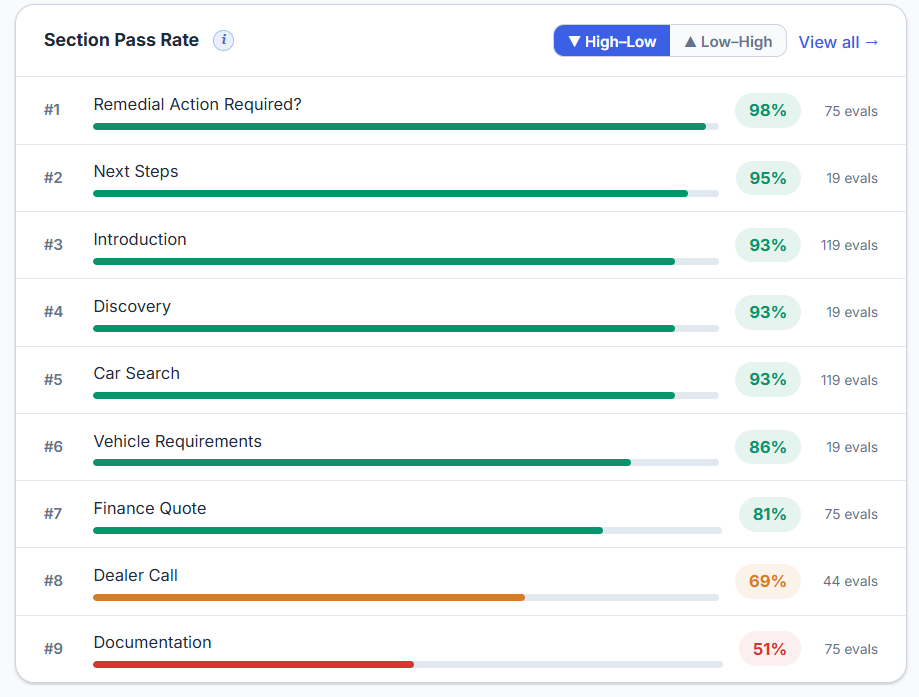
Outcome performance is visible across every team and journey
Better Outcomes reports pass rates by journey stage across every connected interaction. A stage that has started to deteriorate on one team stands out weeks before it would appear in a sampled QA report or a complaints trend.
- Population-level view by team, channel and journey stage
- Emerging deterioration visible early
Step 2 of 4
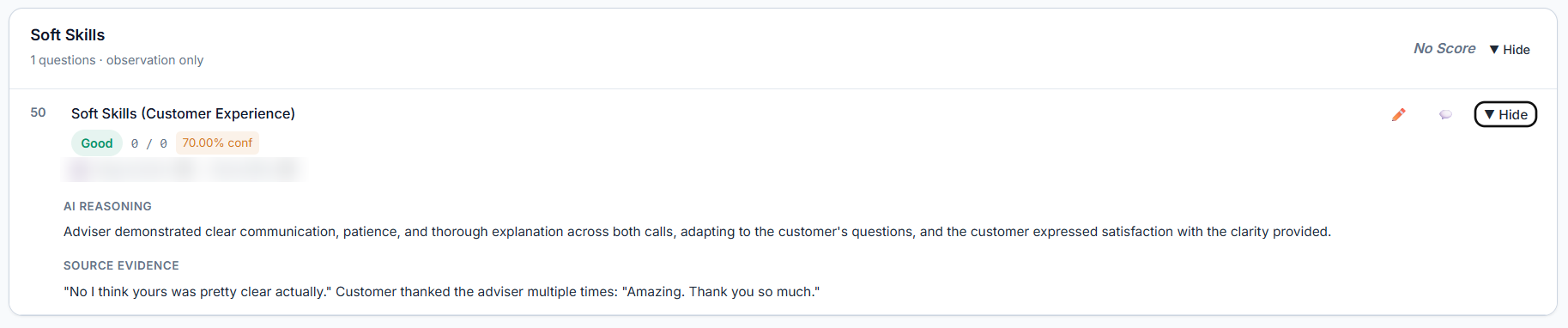
A management figure drills down to its evidence
The risk analyst follows the falling pass rate to the findings behind it. Each finding sets out the AI reasoning beside the verbatim source evidence and the first-line reviewer's decision, so second line can test the first line's judgement, not just its numbers.
- Drill-down from figure to finding to evidence
- First-line review decisions visible to second line
Step 3 of 4
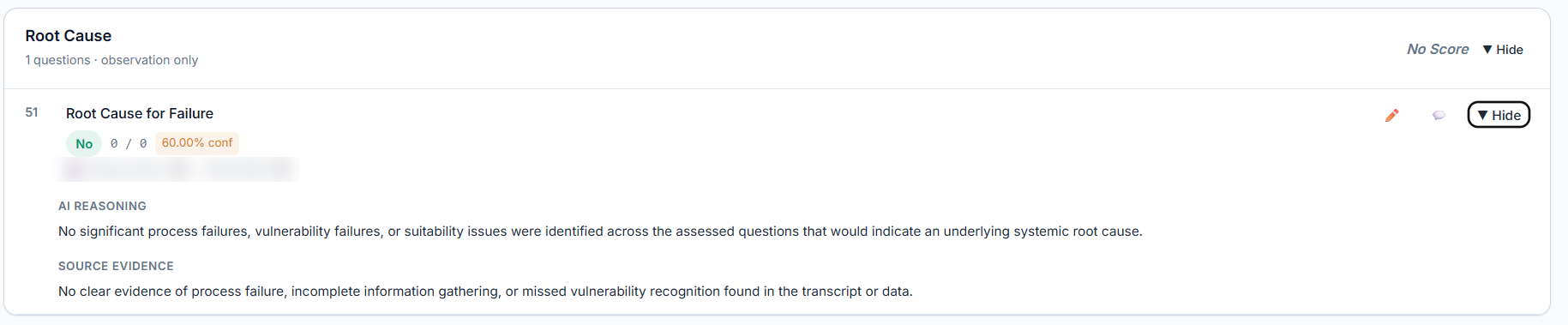
Recurring concerns are grouped as potential systemic issues
Root-cause assessment groups the findings that share a pattern and states the evidence and confidence behind each potential cause. Risk decides what to investigate; the platform presents evidence, not conclusions.
- Recurring areas of concern grouped with evidence
- Insight supports professional judgement - it does not replace it
Step 4 of 4
Governance reporting rests on the population
The KPI view and trend reporting feed the monthly conduct committee with outcome performance over time, emerging themes and the actions taken - each traceable to its evidence in the audit history.
- Governance reporting traceable to source evidence
- Outcome risk monitored over time, not sampled once a quarter



In practice
What this looks like on a real journey.
- Example 01
A monthly conduct committee
Outcome trends by journey stage and team, with the recurring themes behind them, replace anecdotal QA summaries.
- Example 02
An emerging theme
A rising failure rate at one journey stage is visible weeks before complaints about it arrive, with the evidence to investigate.
- Example 03
Second-line assurance
Risk teams sample from the population of findings rather than from raw recordings, and can see the first-line review decisions already taken.
Illustrative scenarios · Findings are surfaced for human review, not decided automatically
The question this answers
“Where is outcome risk emerging?”
What your team gains
- Identify emerging trends
- Monitor outcome performance over time
- Drill from management insight into supporting evidence
- Highlight areas requiring investigation
- Compare outcomes across teams, channels and journeys
- Support stronger governance reporting


Real Better Outcomes product screens · Shown with test data
AI assurance and explainability
AI you can evidence, not just trust.
The AI does not simply generate a score. It produces an assessment that a reviewer can check against the evidence used to reach it - and change if the evidence does not support it.
Your data
Customer data is not used to train public or general-purpose AI models. Products are hosted on UK infrastructure with access segregated by organisation, team and user.
Security and governance/ 01
Configurable outcome frameworks
Your outcome definitions, scorecards and rules - applied consistently across every connected interaction.
/ 02
Evidence behind every assessment
Each finding links to the interaction, CRM record and journey events it was drawn from.
/ 03
Explainable reasoning
The criteria applied and the reasoning followed are shown beside the evidence, not hidden in a score.
/ 04
Human-in-the-loop review
Reviewers confirm, reject, escalate or override - with authority to change the outcome and a recorded rationale.
/ 05
Confidence thresholds
Where applicable, low-confidence findings route to human review before any action is taken.
/ 06
Audit history
Findings, decisions, overrides and model versions are written to an append-only audit history.
/ 07
Configurable escalation
Route confirmed findings to remediation, coaching or compliance queues according to your governance model.
/ 08
Role-based access
Named permissions by organisation, team and role, with MFA and lifecycle management.
/ 09
Reporting and governance
Trend, calibration and override reporting for quality, operations, risk and Board oversight.
/ 10
Data controls
UK product hosting, tenant segregation and defined data scope agreed per deployment.
Frequently asked
Questions buyers ask us first.
- Is AI-generated insight appropriate for governance reporting?
- Better Outcomes presents insight as evidence to support risk, compliance and leadership decisions, with drill-down from every figure to the findings, reasoning and source evidence behind it. It is not a substitute for professional judgement or governance decision-making.
- How does second-line assurance use it?
- Risk teams can sample from the full population of findings rather than from raw recordings, see the first-line review decisions already taken and test calibration between reviewers and the AI.
- How quickly do emerging themes become visible?
- Outcome performance is assessed across every connected interaction as it arrives, so a deteriorating trend at a journey stage or team becomes visible in the reporting well before it would surface through complaints or a periodic sample.
Insights for Risk & Compliance teams
Thinking worth taking back to your team.
- AI Governance9 min readAI adoption does not end at go-liveChristian Henson explains why enterprise AI needs evidence-led assurance from approval and operation through to monitoring and change.Read the essay
- AI & Strategy8 min readThe AI moat isn't the model, it's the evidenceChristian Henson explains why a defensible AI moat comes from protected know-how, governed data, embedded workflow and evidence - not the model alone.Read the essay
Working session
See Better Outcomes on your customer journey.
Bring one representative customer journey and we'll show how Better Outcomes could assess it across interactions, CRM evidence and customer outcomes. No customer data is required for the first session.